The Rijksmuseum van Oudheiden (RMO, National Museum of Antiquities) in Leiden is a must for everyone who loves ancient history and archaeology. It gives a great overview of the Western canon, from Prehistory via Egypt, the Middle East and Greece, to the late Roman era. I feel, but am not sure, that there is a trend that puts more and more emphasis on the Netherlands. Which I think is a good thing, since there is still so much to learn from our own soil, and this is a Dutch museum after all. Latest example: the current Bronze Age exhibition.
I visited the RMO last friday with a witchy friend of mine who also loves history. The exhibition is quite big and gave us ample material for interesting discussions about ancient peoples, herbal magic, sacred places, rituals, and what not. It is set up in a timeline, starting with the Neolithic era and ending with the Iron Age and Middle Ages. The number of objects was huge. Some of the bigger, well known objects turned out to be replicas instead of originals. This was not necessary in my opinion, there were already more than enough interesting original items.
Here is an overview of sorts. Note, it’s by no means complete and consists mainly of things that I find interesting, with an emphasis on Dutch objects, or objects from other areas that I found too interesting or beautiful to ommit. The information I give under each photo is mostly based on the information shown with the objects. The exhibition is on view until March 16th. If you want to learn more, visit the website of the RMO: https://www.rmo.nl/en/exhibitions/temporary-exhibitions/bronze-age/
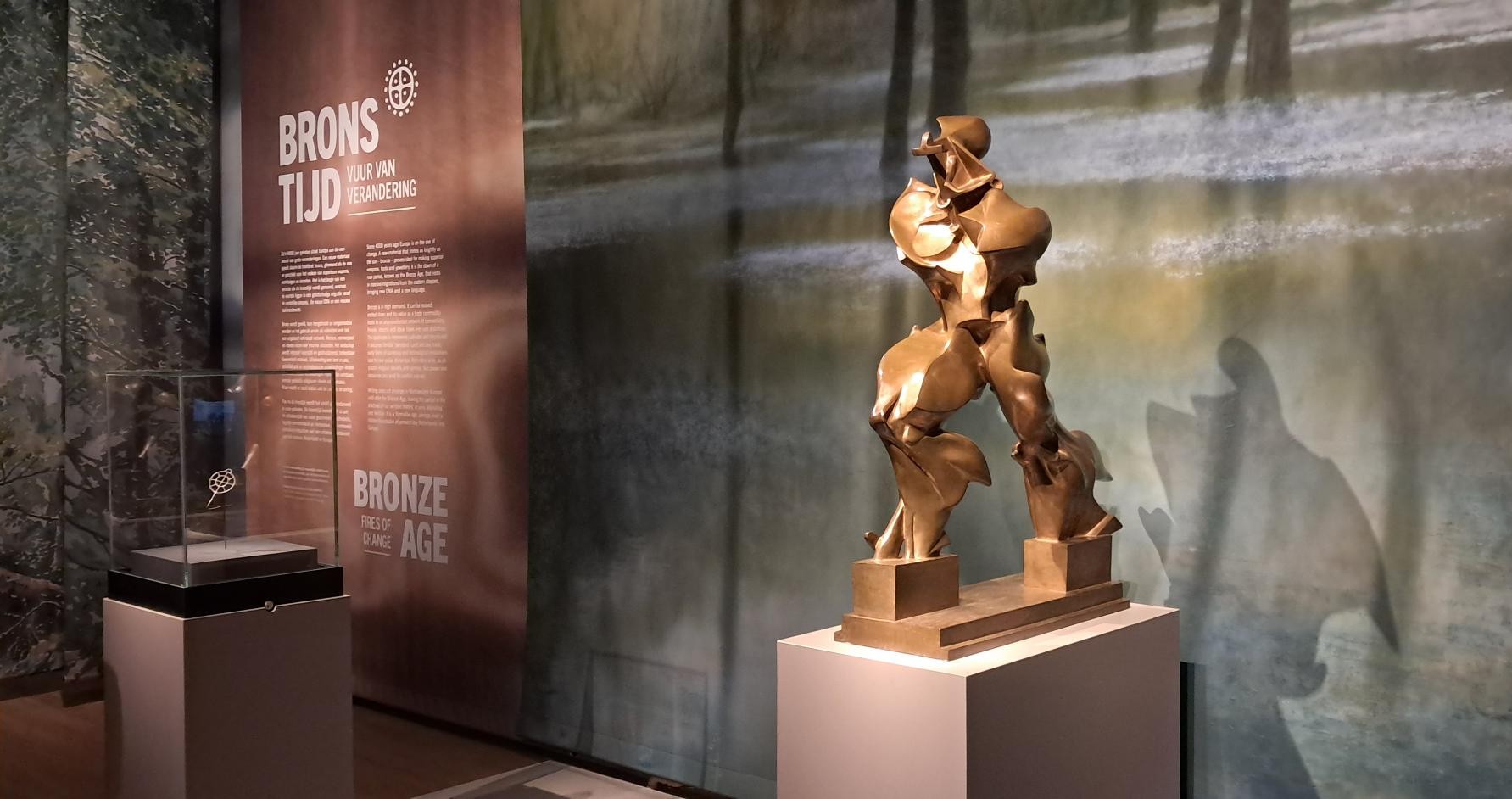
The introduction to the exhibition is playful: an early twentieth century bronze statue by Umberto Boccioni, side by side with a bronze age sun wheel pin (maker unknown).
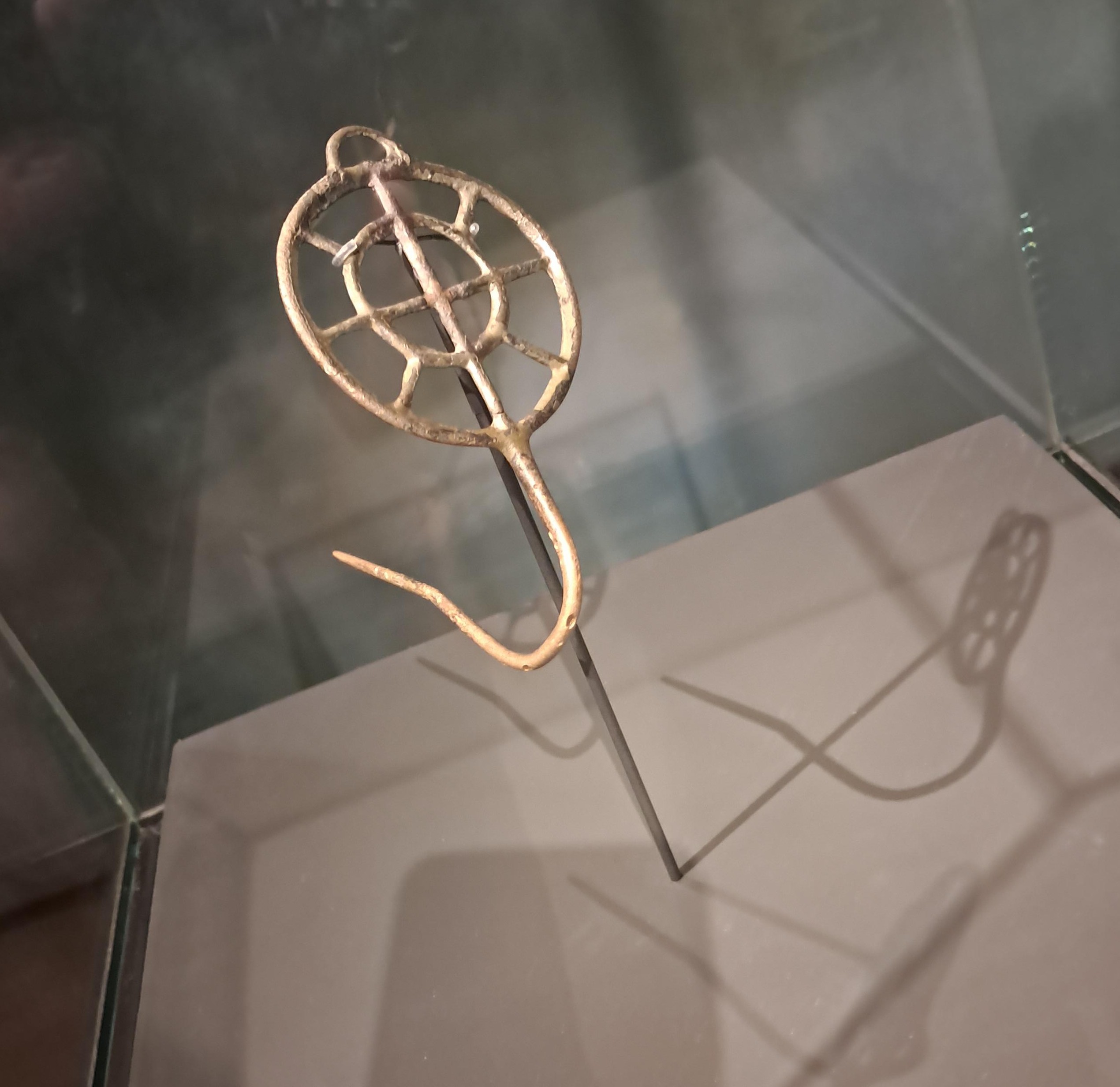
A close up of said pin, from Beek (Gelderland, the Netherlands), 1500-1100 BCE. It, and objects like it, was used to fasten clothes. Pins like these can be found all over Europe, from the north-west to the south-east. The symbol of a cross in a circle is generally known as the sun wheel, and one of the best known and most powerful symbols associated with ancient times in Europe. This pin is bent and was found in a river, typical for an offering.
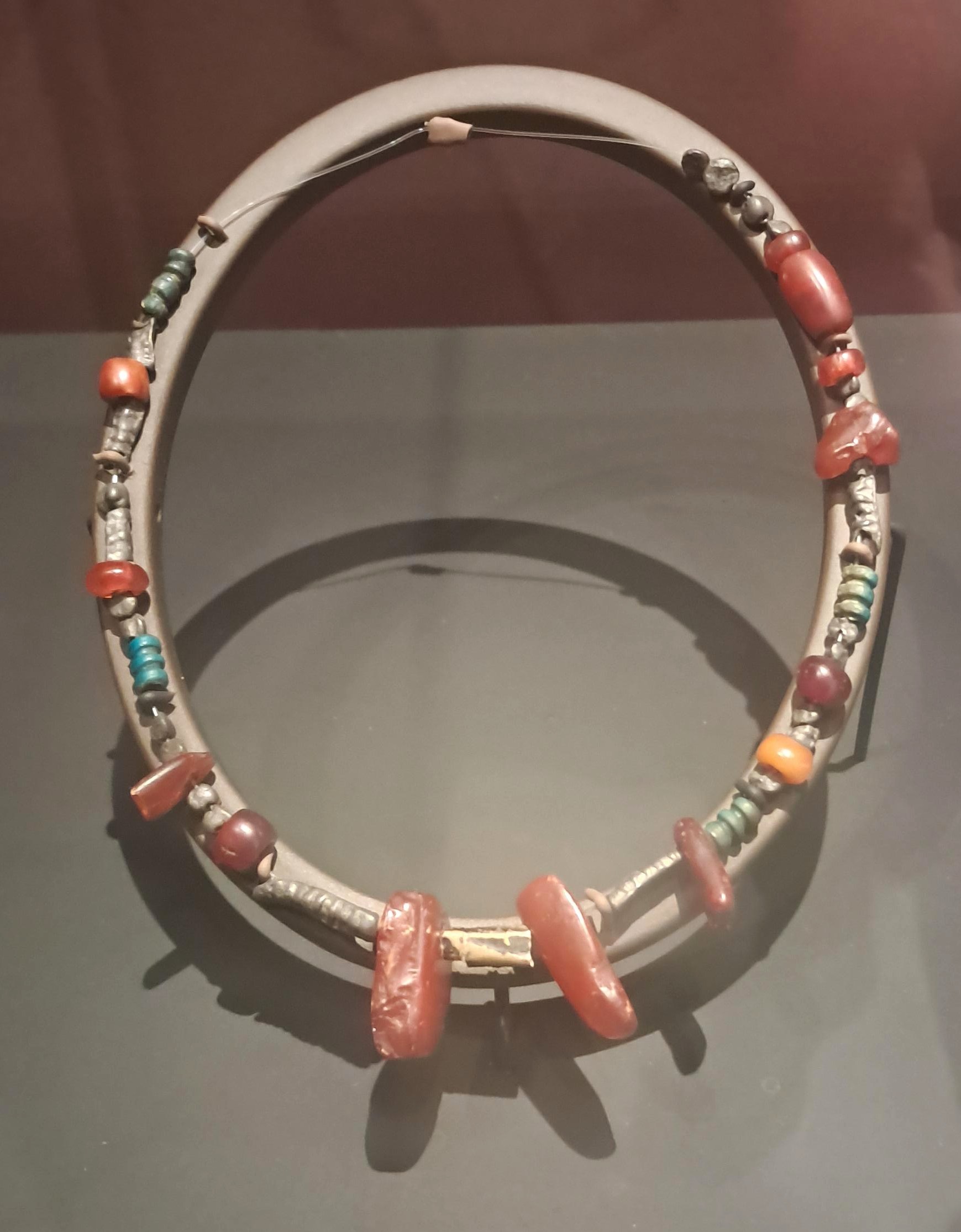
I love how timeless ancient jewelery usually looks. This string of beads was found in 1881 by a farmer, in Exloo (Drenthe, the Netherlands), but was made somewhere between 1800-1500 BCE. The beads were once held together by a fine string made of either hemp, flax or stinging nettle. This object is a perfect example of how connected people from different areas and times were: apart from the gold-coloured sheet-bronze there is amber from the Baltics, and faience and tin from England. Some of the beads seem ‘new’ while others show marks of long usage – maybe heirlooms?
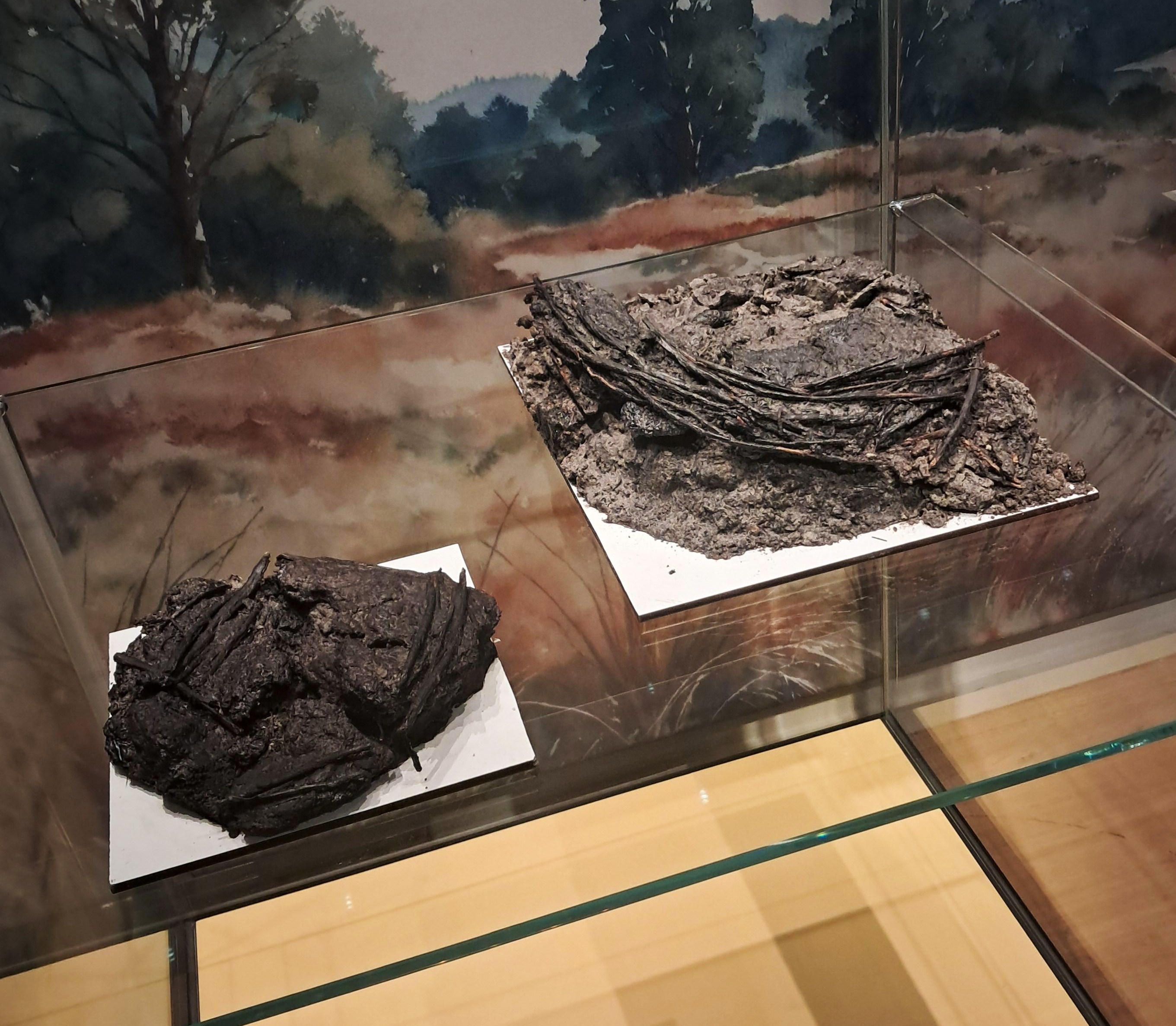
These unseemly looking pieces of earth and plant material provide a treasure of information. They are remains of garlands made of juniper branches, stemming from 1450-1200 BCE. The remains were found in Zuiderloo (Noord-Holland, Netherlands) and were once deposited in an area between dry and wetland – traditionally seen as a place between our world and the spirit world. RMO fittingly heads their information sign with “Het bezielde land / A land of spirits”. The museum also informs that juniper, as an evergeen tree, is connected with eternal life and fertility. My friend, who knows a lot about plants, remarked that juniper is actually a shrub, and that pregnant woman should be careful with ingesting it…which I’ll just leave here.
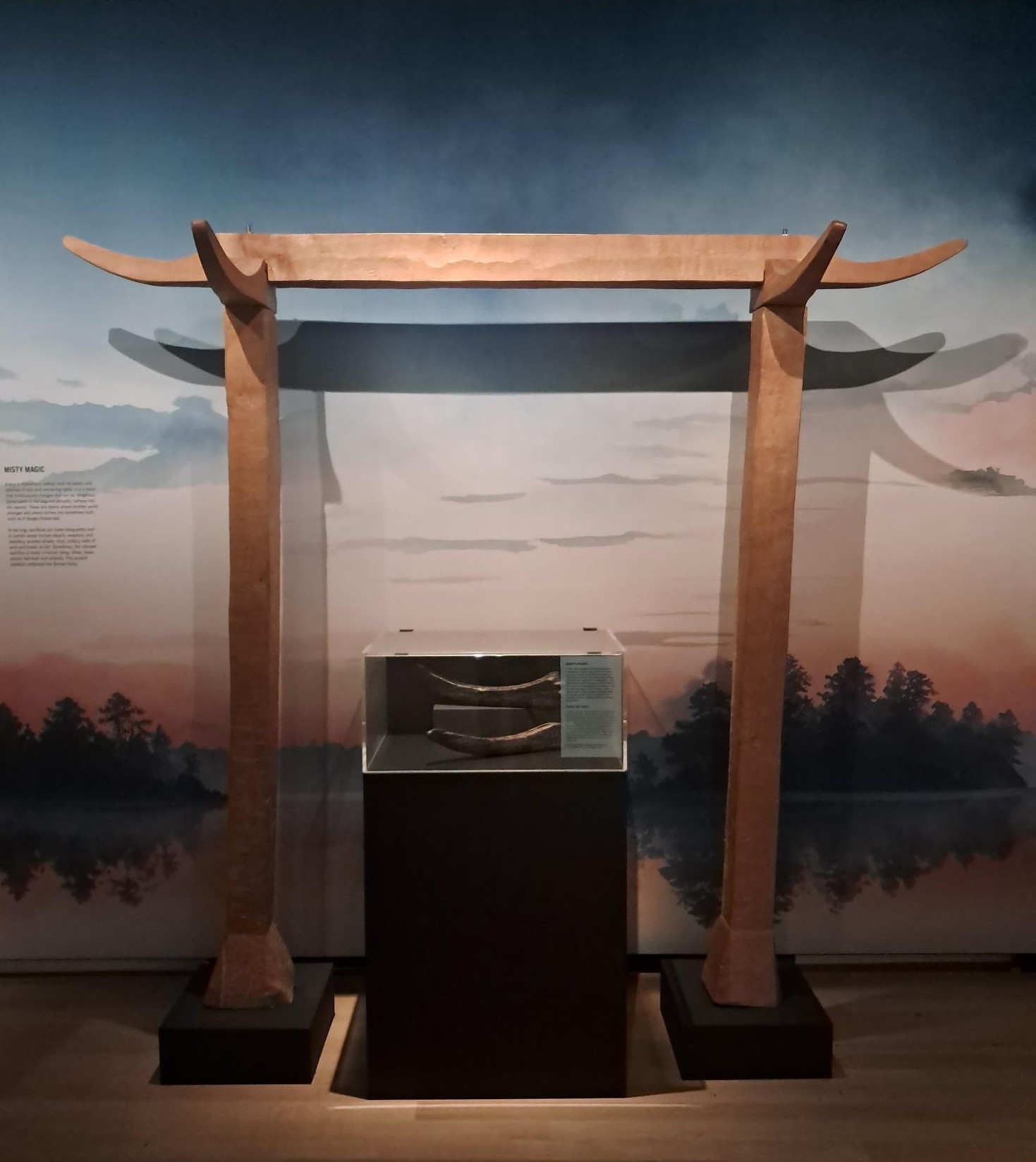
This photo shows a part-construction of what is thought to be a religious or ritual building, the traces of which were found in 1957 in Barger-Oosterveld (Drenthe, the Netherlands). The building, dated 1478-1470 B.C. based on dendrochronology, consisted of four wooden poles on a wooden platform. It was surrounded by 105 boulders. The glass showcase houses the original wooden ‘horns’ which form the ends of the wooden beams placed on top of the poles. It must have been a busy place, as a road as well as many offerings were found near it. Unfortunately, the building was deliberately destroyed.
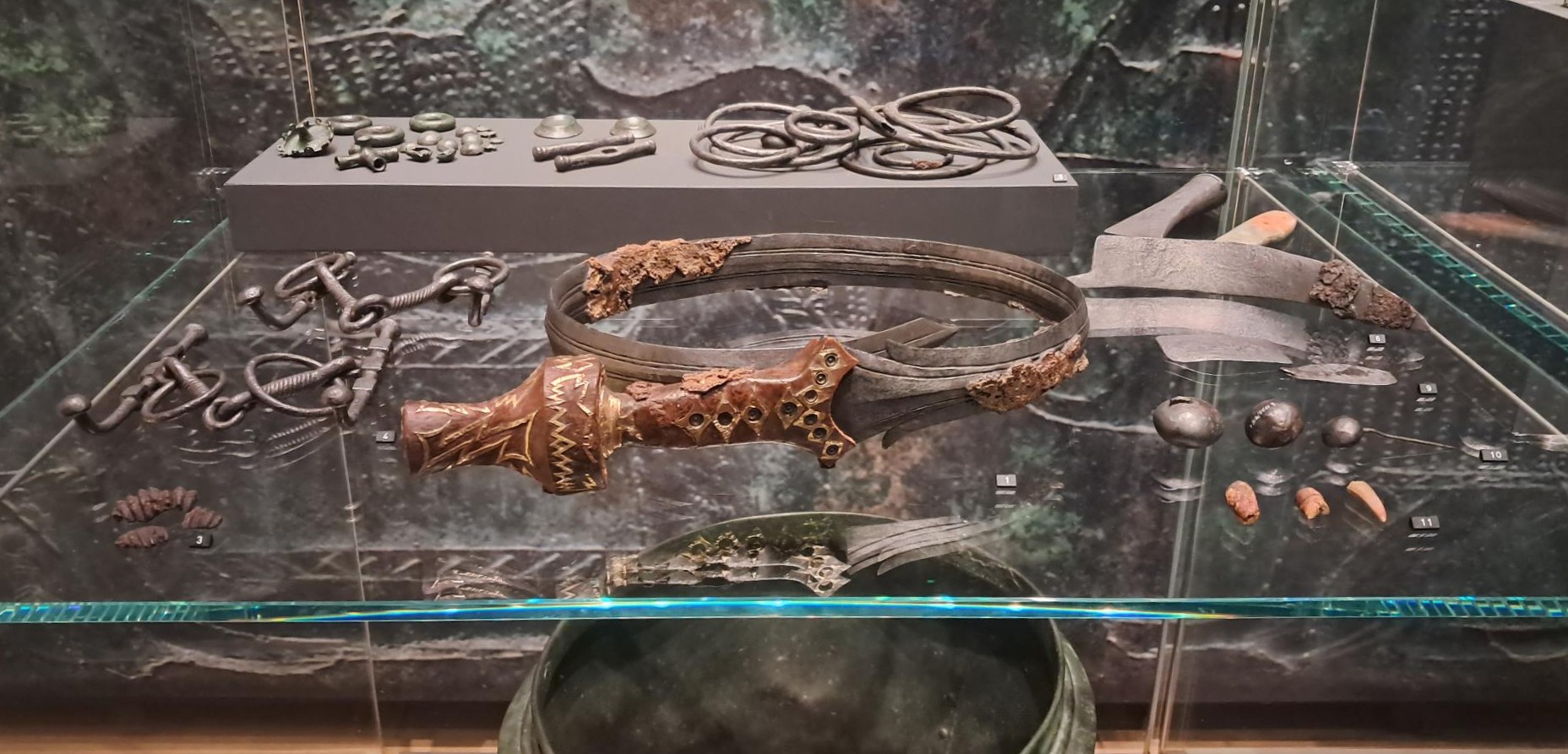
The exhibition contains many impressive treasures and other items. These here are finds from the so-called king’s grave in Oss (Noord-Brabant, the Netherlands), of a man buried somewhere between 800-700 B.C. – post Bronze Age. He was buried in a huge hill (53 meters in diameter), put up over an actual Bronze Age hill. The size of the grave and the buried goods show his importance. The items mostly come from the Hallstatt area in central Europe. They were buried together in a large cauldron. This at least partly explains the bent shape of the spectacular sword (think also of the bent sun wheel pin in one of the above photos; the ‘breaking’ of items probably has a ritual, maybe even magical, meaning).
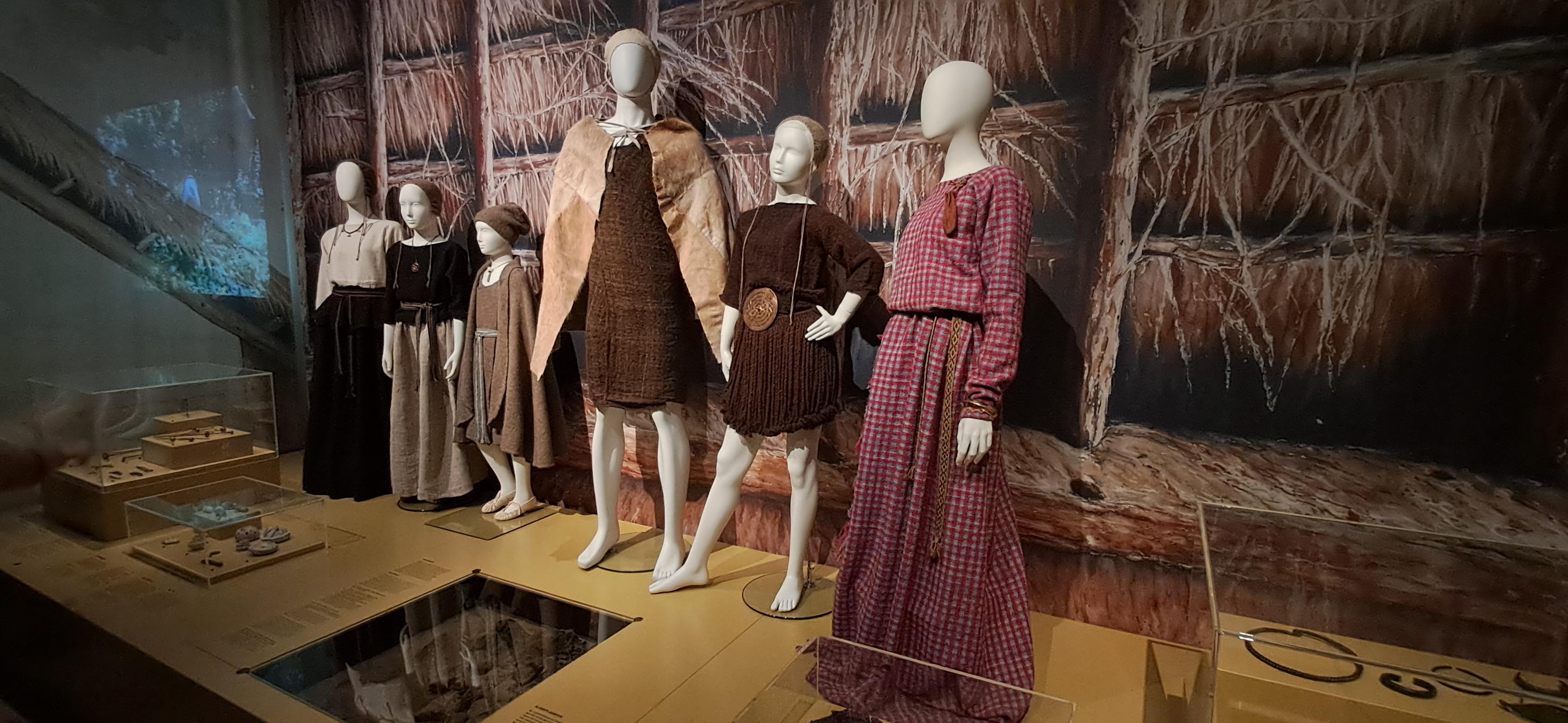
Ancient fashion is probably a lot more diverse than most people realize. The most eye-catching of the above examples is the girl in the short skirt and belt with a large bronze disk. My friend wondered if this wasn’t a bit too modern. But in fact, this outfit is based on the 1921 find of a grave in Egtved, Denmark. In the grave a girl was buried who wore just such clothing. This style was actually not that uncommon in northern Europe during the bronze age.
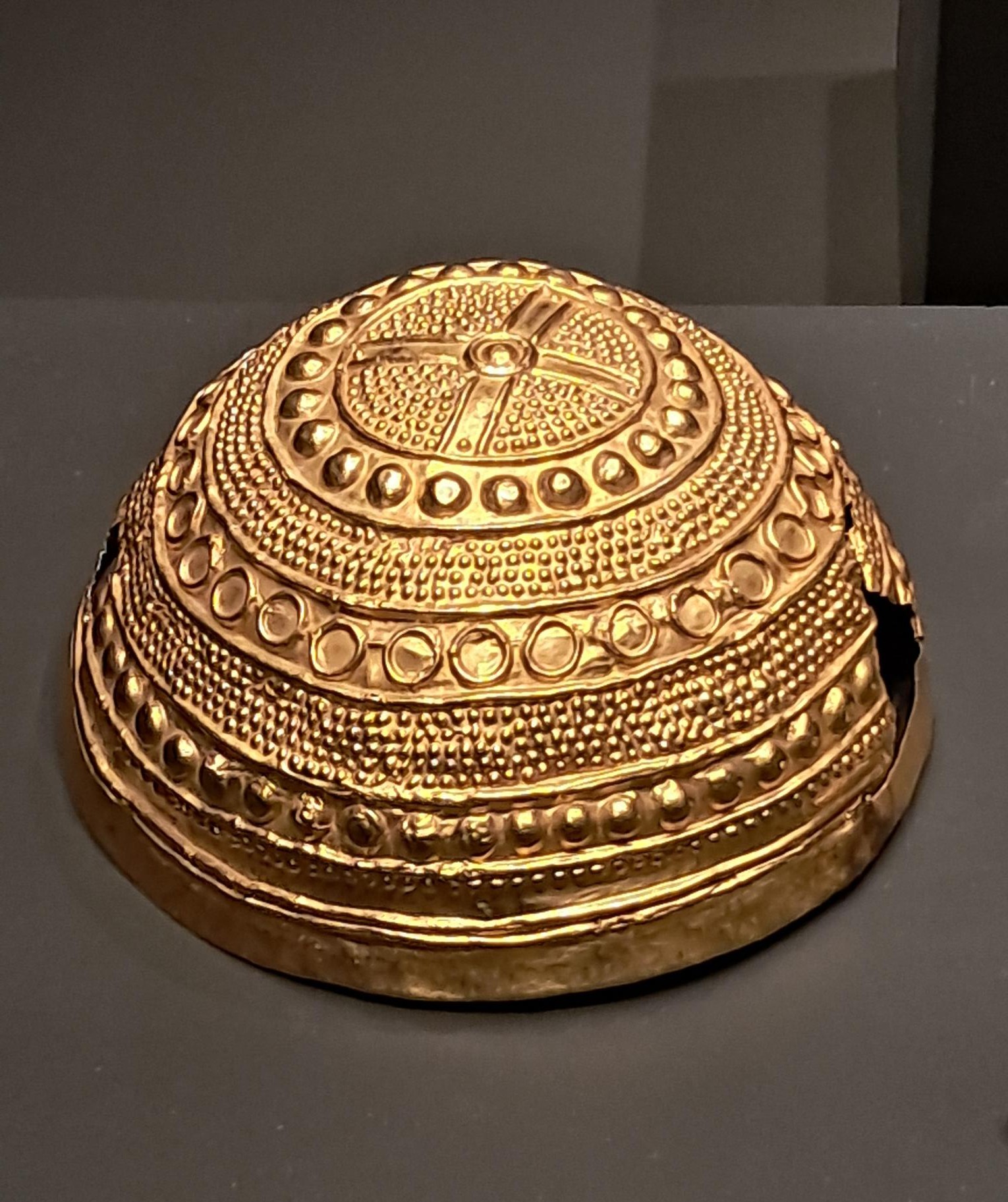
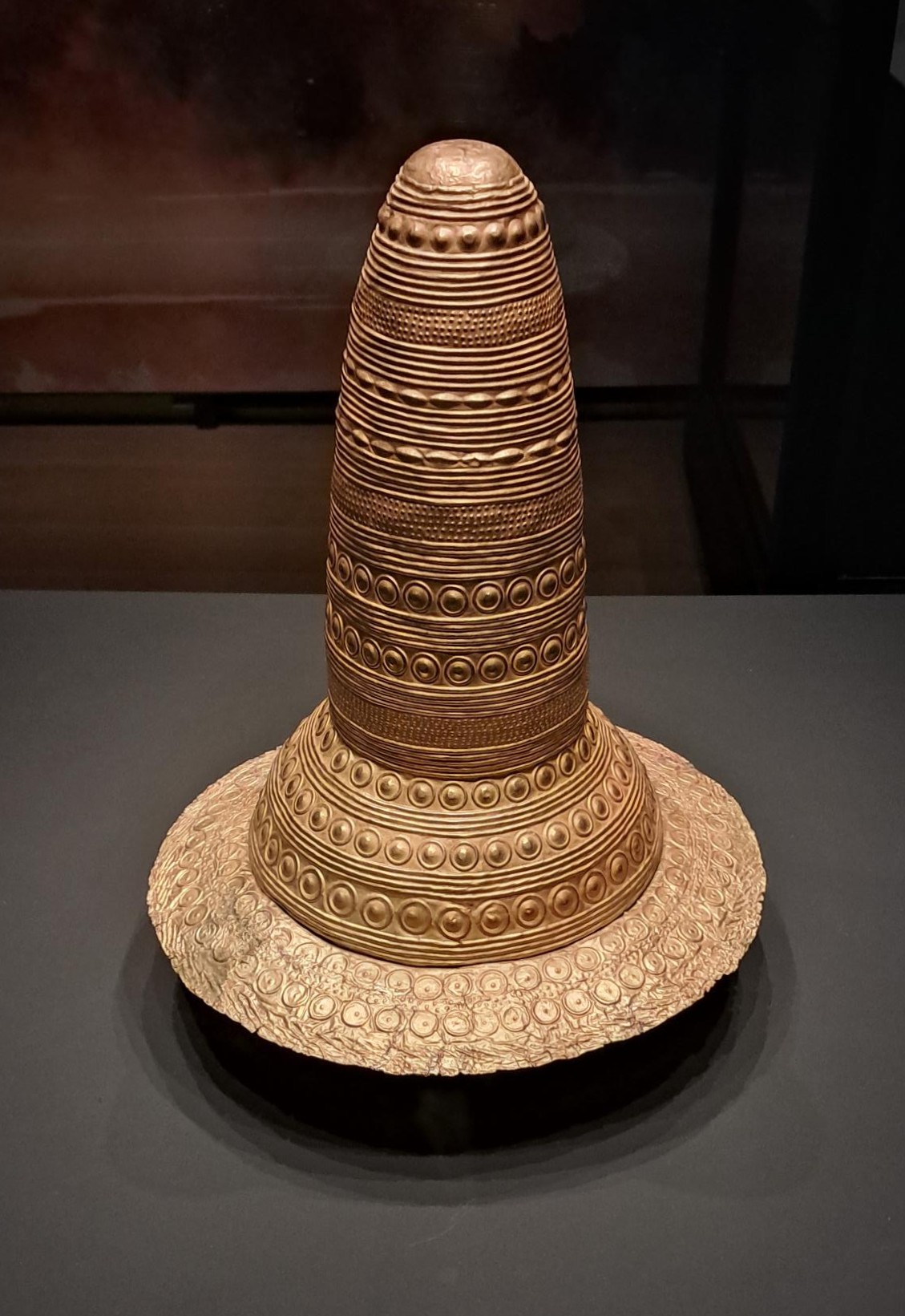
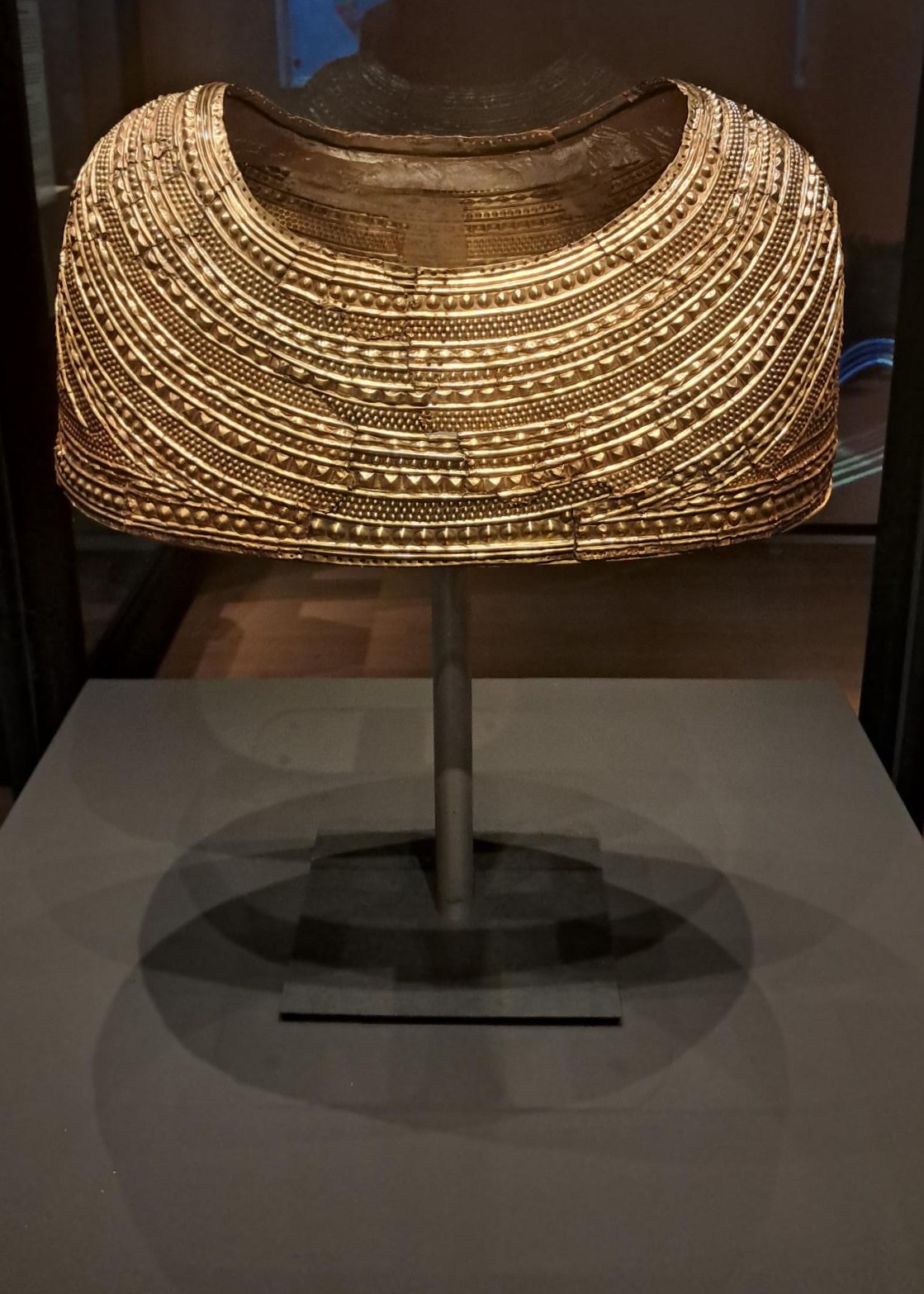
The most impressive room, to me, was the room in which golden objects were exhibited. It’s incredible what people can do with a bit if shiny metal the size of a small pebble…and how long it stays beautiful. From left to right:
- A golden cup from Krottorf (Germany), made around 1400-1300 BCE. It is decorated with sun motifs, notice especially the sun wheel motif – a cross in a circle – in the center. This is a symbol we see several times during this exhibition. The motifs and materials indicate that this was a cup for ceremonial rather than everyday use.
- This ‘hat’ from around 1600 BCE, found in Schifferstadt (Germany) is easily one of the most formidable and puzzling objects in the exhibition. Made from 2,5 cm3 gold, four of these objects have been found so far, three in Germany and one in France. The most popular theory as to its use is as a hat for an important person (priest/ess?) in a sun cult.
- Ancient priest/esse/s seem to have loved uncomfortable clothing. The object on the right, found in Wales, was part of a larger outfit worn as a mantle of cloak covered with amber. It was made somewhere beteen 1900-1600 BCE. The gold mantle shows marks of intensive use and must have been a spectacle of reflecting light during ritual.
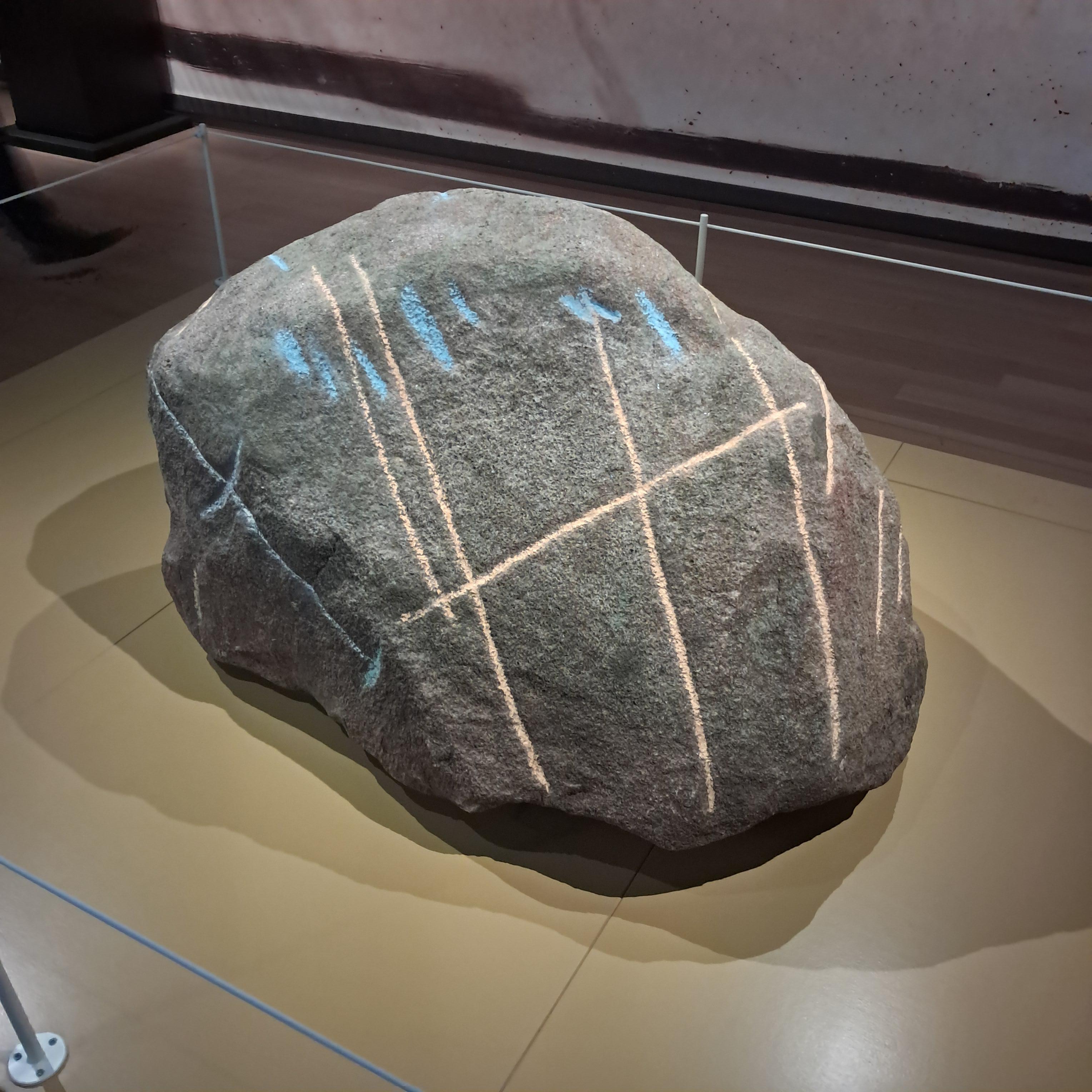
From gold to stone, but these stones can be just such riddles. This exemplar was found in Hezingen (Overijssel, the Netherlands) and the marks on it are thought to date from somewhere between 2000-800 BCE. The dating is mostly based on the place where it was found, a burial mound landscape. The line marks are deliberatie and correspond with similar finds in Germany. But what they mean, no one knows.
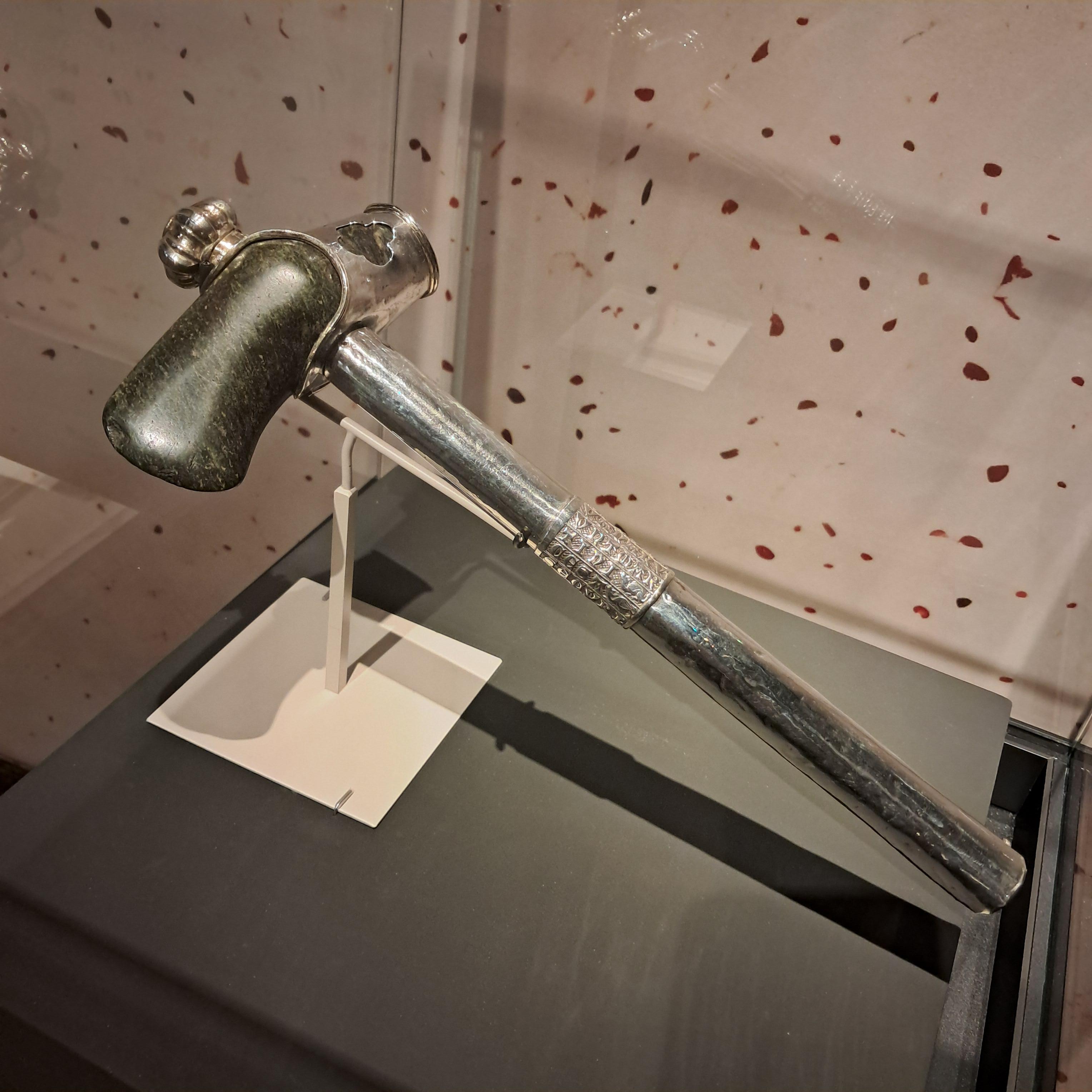
One of the last objects shown is a hammer, made around 1300 CE from silver, with an ancient axe (an Arbeitsaxt) form ca. 1000 BCE. According to legend, Saint Maarten used this hammer to destroy pagan idols. As is also stated in the information sign, it is rather symbolic that an ancient object used by heathens would be incorporated in a christian object used to destroy heathen holy places.


Pingback: Possible ancient precursor to the Wiccan wheel of the year? Also, happy summer solstice! | thimsternisse