A discovery was done in Medel near Tiel (Gelderland, the Netherlands) of a solar observatory. Although similar, larger finds have been done in other places in Europe, this particular find is unique because of its completeness. It gives a lot of insight in Bronze Age people. The finding spot is near a former branch of the Rhine river, and was already lived on during the period of the Bell Beaker Culture (c. 2500-200 BCE), the main culture before the start of the Bronze Age (c. 2000 BCE).
Researchers found three farms from the early Bronze Age (c. 2000-1800 BCE), close by three burial mounds and a burial field. The burial field is about a century older than the mounds and contained about eighty people. The mounds contained about twenty people. One grave in the mounds contained a glass bead. The bead being from c. 2000 BCE, it might come all the way from Mesopotamia, the only known area from that time that produced glass.
Burial mounds 1 and 2, one on each side of the water, were both about 20 meters in diameter and about 1,5 meter high. 30 people were buried here, mostly children en young adults. For eight centuries these mounds were used for burial. The first people were buried in a squatted position, in later centuries there ashes were buried, so their bodies were burned first. A significant detail is three seperate skulls that were found. There is a third smaller mound that covers the grave of one older man, from the Middle Bronze Age, the same period as when the ashes were buried in the other mounds.
Burial mound 1 is remarkable. It was built on an older burial mound from the Bell Beaker period. Furthermore, the mound was surrunded by a ditch with ten small interruptions or portals, from c. 1900 BCE. The ditch corresponds with the Bell Beaker burial mound and not with the later Bronze Age mound. The ‘portals’mark the moments of sunrise and sunset throughout the year. Reasearches conclude that this must have been a solar observatory.
The days marked are Midsummer, Midwinter, and the cross quarter days (beginning of February/November and beginning of May/August). These cross quarter days, together with the solstices and eqiunoxes, divide the calander in eight parts (this may sound very familar to modern witches and pagans). The last two portals roughly mark the north and the south. The burial mound group is alligned east-west and therefore mark the equinoxes.
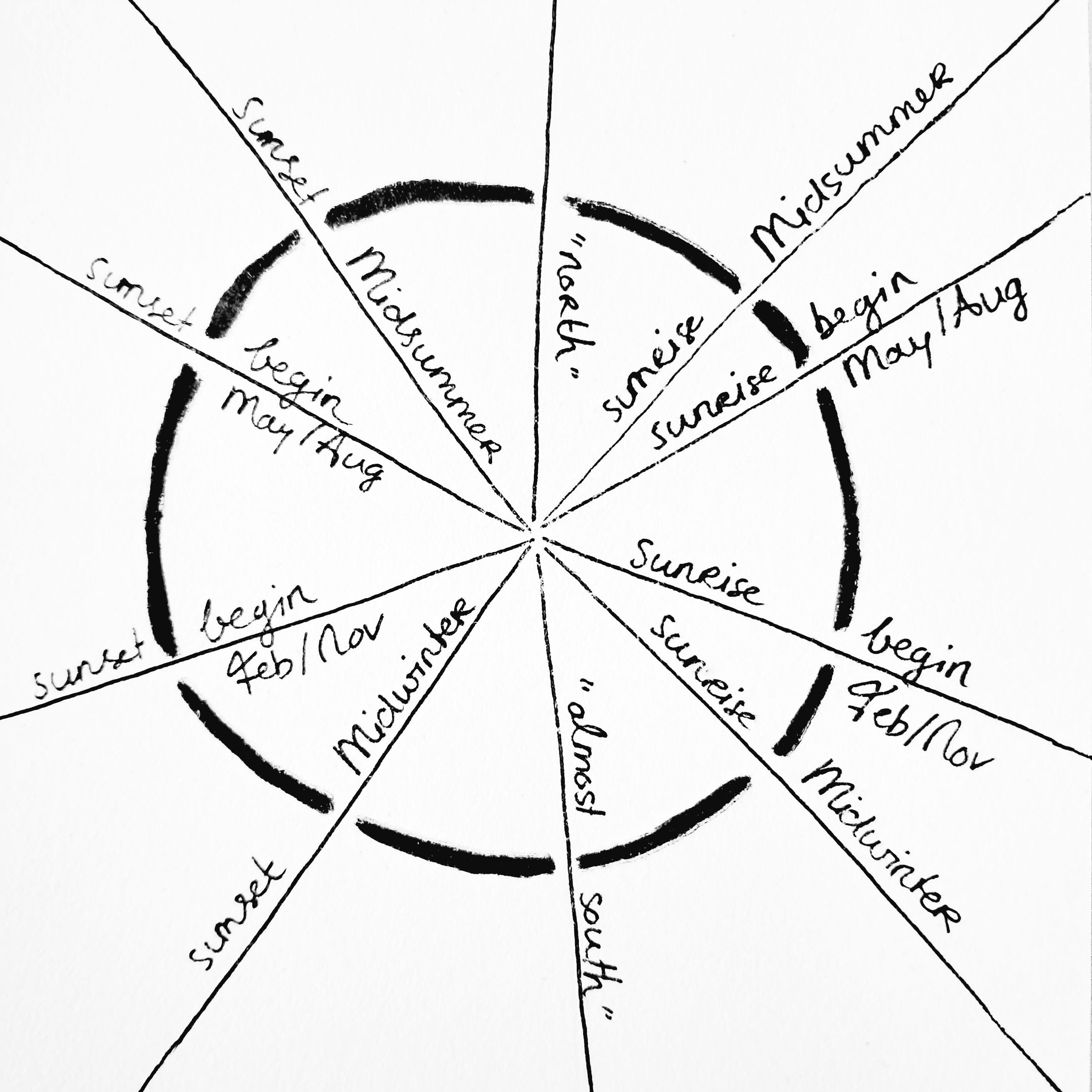
Researchers drew imaginary lines from the center of this observatory through the ‘portals’ and discovered more objects and structures. Examples are bronze objects, pits with animal remains, fire pits, and metalworking tools. Some pits contains actual wooden staris and might have been used as ritual bathing pools.
If one draws a line through the southern ‘portal’ and keeps on going, after 200 meter they will end up at the oldest skull pit in the burial field containing the previously mentioned glass bead. The northern line goes through a pit with animal bone jewellery and an offering pit on top of the older Bell Beaker finding place.
Similar finds were done around the other two burial mounds. If one draws a line from the place that marks the Midsummer sunrise, this marks a bronze arrow tip, the Midwinter line marks a bronze spear point, and the line marking the beginning of February/November crosses a pit with two bovine skulls.
From all this, researchers conclude that this place marks a relatively simple solar observatory, built by a small community of farmers in the Bronze Age, to help guide them through the seasons, to know when to sow and reap, when to take the cattle in or out, etc. Researchers think that the dates marked by the observary were celebrated by the Bronze Age people. The strong connection with the burials in the area, probably point towards a cosmological belief system in which the path of the sun and the seasons are connected to the cycle of life, death and rebirth. It might be that the people who built the observatory on the burial mounds believed that the ancestors helped them maintaining a balance between the forces of nature. Hence the many offerings and other ritual finds found in this area. These beliefs are very ancient, may go all the way back to the Neolithic, and can still be found with some contemporary people (including modern pagans).
Source
Chris van der Linde, “Een zonne-observatorium uit de bronstijd. Onderzoek in Tiel-Medel”. In Luc Amkreutz and Sasja van der Vaart-Verschoof (ed.) Bronstijd, vuur van verandering. Leiden: Sidestone Press, 2024. p. 111-113.
 thimsternisse